

This year’s report – USGLC’s largest analysis of policy recommendations – found a wide range of views on America’s role in the world. And we found common ground – a clear consensus for using diplomacy and development to tackle six global challenges that are critical to America’s health, security and economic interests.

The Global Plum Book identifies the 100 key political appointed positions in an Administration who are responsible for development and diplomacy policy. Get background and bios on all the latest appointments at the White House, State Department, USAID, and beyond.
The U.S. Global Leadership Coalition (USGLC) is a broad-based influential network of 500 businesses and NGOs; national security and foreign policy experts; and business, faith-based, academic, and community leaders in all 50 states who support a smart power approach of elevating development and diplomacy alongside defense in order to build a better, safer world. The USGLC works in our nation’s capital and across the country to educate and inspire support from the American public and policymakers on the importance of America’s civilian-led tools of development and diplomacy. By advocating for a strong and effective International Affairs Budget, the USGLC is working to make the smart power tools of development and diplomacy a keystone of America’s engagement with the world.
Synthetic drug use and addiction – including opioids and illicit fentanyl – is one of the most devastating public health and geopolitical crises with widespread implications for the U.S. economy and national security. The U.S. Global Leadership Coalition (USGLC) has prepared a brief on leveraging bilateral diplomacy and cooperation as civilian toolkit can address the growing domestic and worldwide crisis on fentanyl and synthetic drugs to protect American lives
Investments in women and girls are a force multiplier for diplomatic and development gains alike, from longer lasting peace deals to advancing economies to improving child nutrition, health, and school attendance. The U.S. Global Leadership Coalition (USGLC) has prepared a brief on why empowering women and girls around the world is a critical bipartisan priority.
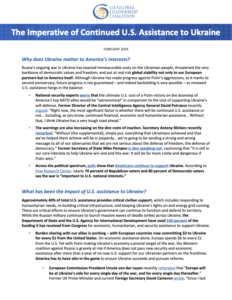
Russia’s invasion of a sovereign nation has not only exacted immeasurable costs on the Ukrainian people, it also threatens global stability, directly impacting American stability. The U.S. Global Leadership Coalition (USGLC) has prepared Q & A on the importance of U.S. leadership and assistance to Ukraine, highlighting both the national security and economic impact on the U.S., as well as our allies’ and partners’ continued support and accountability and transparency of U.S. assistance.
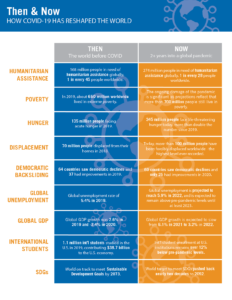
Life before March 2020 can sometimes be remembered with rose colored glasses. It was in ways a simpler time when a deadly virus had yet to claim over 1 million American lives and everything from economic stability to conflict to global unemployment was different.
Check out our Then & Now graphic below for a snapshot of what the world looked like then, before COVID-19, and now, two years later.
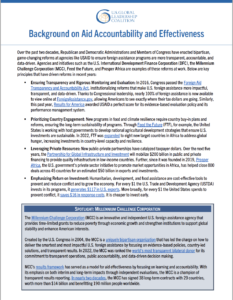
Since 9/11, Republican and Democratic Administrations and Members of Congress on both sides of the aisle have enacted reforms to ensure foreign assistance is more transparent, accountable, and data-driven to deliver the greatest results.

Today, 811 million people go to bed hungry every night, illustrating extraordinary levels of food insecurity and the far-reaching impact of current crises around the world. Continued supply chains disruptions from the COVID-19 pandemic and Russia’s invasion of Ukraine have exacerbated social, political, and economic challenges.
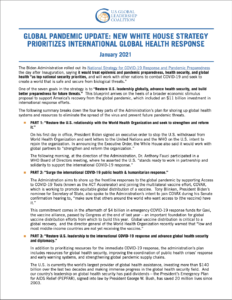
The Biden Administration rolled out its National Strategy for COVID-19 Response and Pandemic Preparedness the day after Inauguration, saying it would treat epidemic and pandemic preparedness, health security, and global health “as top national security priorities, and will work with other nations to combat COVID-19 and seek to create a world that is safe and secure from biological threats.” One of the seven goals in the strategy is to “Restore U.S. leadership globally, advance health security, and build better preparedness for future threats.”
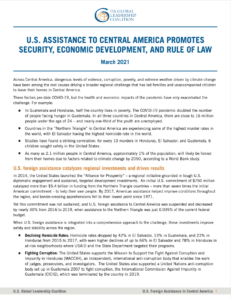
Across Central America, dangerous levels of violence, corruption, poverty, and extreme weather driven by climate change have been among the root causes driving a broader regional challenge that has led families and unaccompanied children to leave their homes in Central America. These factors pre-date COVID-19, but the health and economic impacts of the pandemic have only exacerbated the challenge.
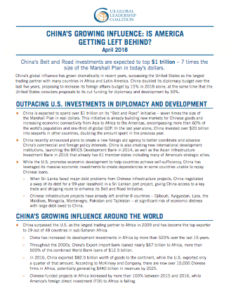
The People’s Republic of China’s global investments have grown dramatically in recent years, surpassing the United States as the largest trading partner with many countries in Latin America and Africa and challenging America’s strategic influence across the globe. From official investments in key industries like infrastructure, aerospace, and power to investments by Chinese state-owned companies in new technologies like 5G, China has pledged to become a world economic leader by 2025 through global manufacturing.
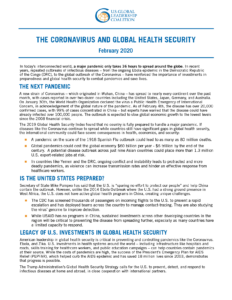
In today’s interconnected world, a major pandemic only takes 36 hours to spread around the globe. In recent years, repeated outbreaks of infectious diseases – from the ongoing Ebola epidemic in the Democratic Republic of the Congo, to the global outbreak of the Coronavirus – have reinforced the importance of investments in preparedness and global health security to combat pandemics and save lives.
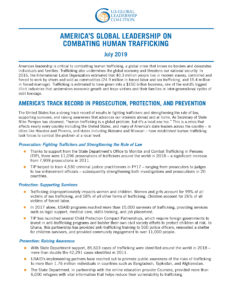
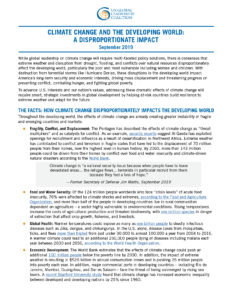
While global leadership on climate change will require multi-faceted policy solutions, there is consensus that extreme weather and disruption from drought, flooding, and conflicts over natural resources disproportionately affect the developing world, particularly the poor and most vulnerable including women and children.
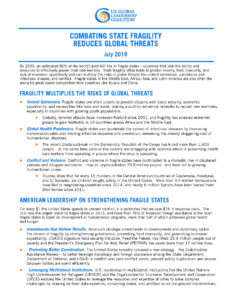
By 2030, an estimated 80% of the world’s poor will live in fragile states – countries that lack the ability and resources to effectively govern their own territory. State fragility often leads to greater poverty, food insecurity, and lack of economic opportunity and can multiply the risks of global threats like violent extremism, pandemics and infectious disease, and conflict. Fragile states in the Middle East, Africa, Asia, and Latin America are also often the arena for great power competition from countries like Russia and China.
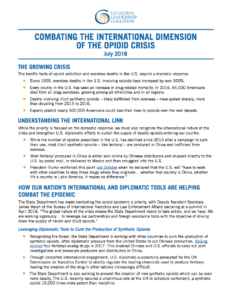
The horrific facts of opioid addiction and overdose deaths in the U.S. require a dramatic response. While the priority is focused on the domestic response, we must also recognize the international nature of the crisis and strengthen U.S. diplomatic efforts to curtail the supply of deadly opioids entering our country.
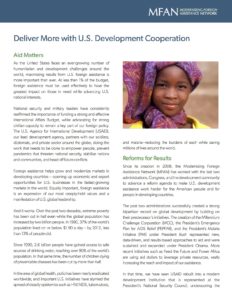
As the United States faces an ever-growing number of humanitarian and development challenges around the world, maximizing results from U.S. foreign assistance is more important than ever. At less than 1 percent of the budget, foreign assistance must be used effectively to have the greatest impact on those in need while advancing U.S. national interests. Read MFAN’s recommendations on what more can be done to strengthen our development agencies, like USAID, and increase the impact of U.S. assistance.
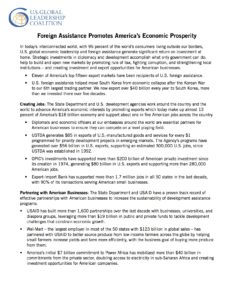
With 95 percent of the world’s consumers living outside our borders, U.S. global economic leadership and foreign assistance generate significant return on investment. Strategic investments in diplomacy and development accomplish what only government can do: help to build and open new markets by promoting rule of law, fighting corruption, and strengthening local institutions—and creating investment and export opportunities for American businesses. Read about the economic benefits that global U.S. development and diplomacy programs have for our economic prosperity here at home.
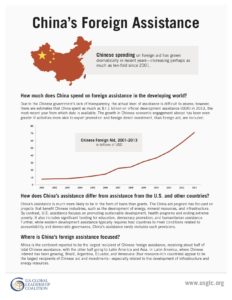
Chinese spending on foreign aid has grown dramatically in recent years—increasing perhaps as much as ten-fold since 2001. China’s assistance is much more likely to be in the form of loans than grants. The China aid program has focused on projects that benefit Chinese industries, such as the development of energy, mineral resources, and infrastructure. Read how Chinese foreign aid differs from American foreign aid, and where the main focus of Chinese assistance currently lies.
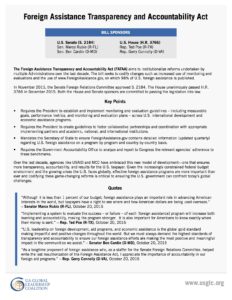
The Foreign Assistance Transparency and Accountability Act (FATAA) aims to institutionalize reforms undertaken by multiple Administrations over the last decade. The bill seeks to codify changes such as increased use of monitoring and evaluations and the use of www.ForeignAssistance.gov, on which 98 percent of U.S. foreign assistance is published. Read more about the key points of the bill and quotes from bipartisan members of Congress who have shown their support for more transparent and accountable aid.
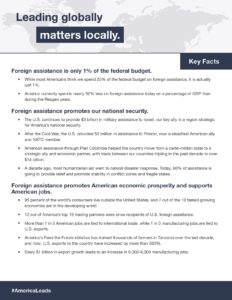
Our nation’s strategic investment in global development and diplomacy not only matters overseas—it matters right here at home for our security, economy, and values as a nation. For just a penny on the dollar, the International Affairs Budget saves lives, reduces conflict, boosts our national security, and expands our economy—an unmatched return on investment that creates a stronger America and a better world for all. In this document are key facts and examples that highlight the importance of American foreign assistance.
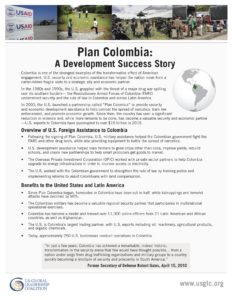
Colombia is one of the strongest examples of the transformative effect of American engagement. U.S. security and economic assistance has helped the nation move from a cartel-ridden fragile state to a strategic ally and economic partner. Read an overview of Plan Colombia and the benefits it has created for the United States and Latin America.
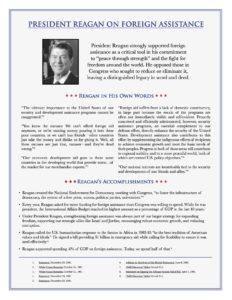
President Reagan strongly supported foreign assistance as a critical tool in his commitment to “peace through strength” and the fight for freedom around the world. He opposed those in Congress who sought to reduce or eliminate it, leaving a distinguished legacy in word and deed. Read more on Reagan’s legacy of U.S. foreign assistance and American global leadership.
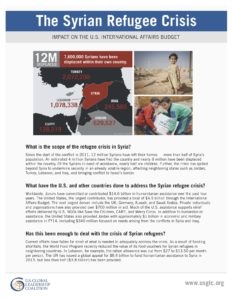
Since the start of the conflict in 2011, 12 million Syrians have left their homes — more than half of Syria’s population. An estimated 4 million Syrians have fled the country and nearly 8 million have been displaced. Read facts about the Syrian Refugee Crisis, and learn how American leadership is helping to overcome one of the worst humanitarian crises since World War II.
Over the last 15 years, Republican and Democratic Administrations have reformed the U.S. Agency for International Development (USAID) to strengthen its capacity to deliver results-driven, transparent, and accountable foreign assistance in the fight against global poverty. Read about the evolution of reform at USAID, and how the agency is catalyzing new commitments to tackle global challenges in health, agriculture, and energy, while also leveraging limited taxpayer dollars for an impact at scale.
American taxpayers rightfully demand government agencies deliver results. Over the last decade, Republican and Democratic Administrations have transformed the U.S. Agency for International Development (USAID) into a more effective, results-driven agency that ensures accountable and transparent foreign assistance. Read how America’s lead development agency for most U.S. foreign assistance, USAID, is achieving results and ensuring that America’s development investments are sustainable and maximized.
The USGLC reviewed over 60 reports by think tanks, NGOs, and national security and foreign policy experts from across the political spectrum on ensuring America’s civilian tools of national security advance our security and economic interests around the world. These reports focused on a broad range of issues with a wide spectrum of recommendations – from one suggesting moving USAID into the State Department to the other extreme of consolidating all of government-wide development programs into an elevated Cabinet-level agency headed by USAID. Neither of these two positions carry significant bipartisan support. However, there is consensus on seven key areas – among the vast majority of reports – to strengthen, improve, and reform diplomacy and development. While reports offer different options as to how to tactically implement these areas of reform, these seven areas of consensus provide a smart pathway forward for the reform agenda.
In today’s interconnected world, America’s economic prosperity is directly tied to the global economy. The reasons are simple: 95 percent of the world’s consumers live outside the United States, and international trade supports 41 million American jobs. This means that the United States cannot turn its economic sights inward and hope to thrive, and American businesses cannot sell only to a domestic audience and expect to compete globally. The Economic Brief makes the case for the economic value of U.S. foreign assistance for American businesses.
The 2012 Report on Reports analyzes over 30 reports from a wide political spectrum and identifies six areas of broad agreement, focused on making existing initiatives more effective and impactful, and new ideas for innovative approaches to meet the challenges and opportunities of the future. America has a unique opportunity to build upon the bipartisan efforts of the past decade of strengthening development and diplomacy efforts to advance the country’s foreign policy and national security interests. After reviewing the stream of reports, articles, policy briefs, and other documents over the past few years, the USGLC has again found strong consensus on the next steps to ensure effective foreign assistance and to strengthen our civilian agencies.
Extraordinary global challenges from terrorism to weak and fragile states to enduring poverty demand strong U.S. leadership and a new vision for American engagement in the world. Over the past decade, the importance of using all the tools of our foreign policy to shore up our national security—development and diplomacy, alongside defense—has had strong bipartisan support. But today, our position in the world is being challenged economically as well. That’s why we need Smart Power 2.0, a strategic investment in effective development and diplomacy that enables us to advance our national security interests abroad, as well as, better compete in the global marketplace. For just one percent of the federal budget, programs funded through our International Affairs Budget protect our security and advance our economic interests in the world, while demonstrating our finest values as a nation.
Get the latest news, advocacy, and event updates from the USGLC
Copyright 2024 USGLC | Privacy Policy

