
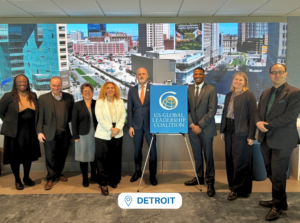
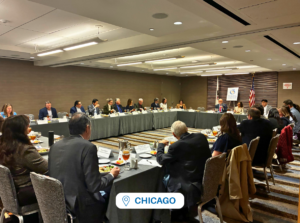
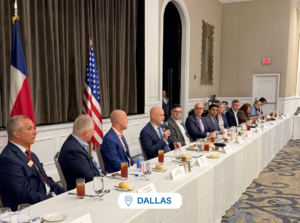
The U.S. Global Leadership Coalition hosted three roundtables in Chicago, Detroit, and Dallas at the end of April with Paul Marin, Director of Public Affairs for the U.S. Trade and Development Agency (USTDA). Convening local business, nonprofit, agriculture, and government leaders, the discussions focused on how smart, strategic investments in international assistance and diplomacy—through agencies like USTDA—help America compete and win on the world stage.
On the heels of the nationwide events, USGLC asked Paul Marin a few questions about how USTDA strengthens America’s global competitiveness and why early-stage investment in emerging markets is key to unlocking opportunities for American businesses.
1. USTDA has supported more than $127 billion in American exports since its inception, creating jobs in communities across all 50 states. How would you describe USTDA’s role in the U.S. foreign policy apparatus—and why should everyday Americans care about what it does?
We have a unique mission. USTDA is a first mover on the development of critical infrastructure projects in emerging markets. We focus on areas including critical minerals, digital, energy and transportation infrastructure, supporting projects that meet the shared strategic priorities of the United States and our overseas partners. I describe our work as catalytic—we fund the upfront planning that accelerates a project’s development and helps it attract financing.
USTDA’s proven formula puts a lot of points on the board for our country. We work closely with the National Security Council, the Departments of State and War, and others to ensure all our programming is aligned with U.S. national security interests, while simultaneously supporting the priorities of our partners. Our partner countries gain access to trusted U.S. technology and high-quality infrastructure to support their economic growth and energy security. And U.S. companies win overseas contracts and become more globally competitive. Our work really does help strengthen America’s standing in the world.
The $127 billion is one important outcome of our program. It reflects the U.S. exports that have resulted from our work. This translates into $226 in U.S. exports, on average, for every congressionally appropriated dollar that USTDA has programmed. This is a very strong return on investment.
2. You just wrapped roundtables with business, civic, and community leaders in Detroit, Chicago, and Dallas — regions with deep stakes in international trade, from Michigan’s manufacturing sector to Texas’s energy industry to Chicago’s role as a freight and logistics hub. What did those conversations reveal to you about how American businesses and communities see U.S. engagement abroad?
My main takeaway is that these businesses and communities want to deepen America’s engagement around the world because this engagement opens pathways to exporting home-grown technology, manufactured goods and services overseas. Agencies like USTDA help create these pathways.
These businesses and communities really embraced USTDA’s mission, and they were quick to note how America’s economic security and national security are intrinsically linked. We also talked about mobilizing capital and deploying U.S. private sector innovation and energy solutions overseas. In addition to supporting our partner countries, this strategy makes our private sector stronger and more globally competitive, and our country stronger and more secure.
3. For every $1 USTDA invests, it generates $226 in U.S. exports. How does a USTDA project overseas actually translate into jobs and economic opportunity for American workers and businesses back home?
Our project preparation work helps to de-risk projects by providing information and analysis that give financial institutions the confidence to lend. With this capital in hand, our overseas partners can implement their projects and procure the U.S. goods and services that our studies recommend for their projects.
For USTDA, this has translated into $127 billion in U.S. exports, including from small businesses in approximately 380 communities across the United States.
4. USTDA operates at the intersection of trade, infrastructure, and diplomacy — working alongside agencies like the DFC, MCC, and the Export-Import Bank. How do you think about economic engagement abroad as a national security tool, and what does that mean for America’s ability to compete globally?
USTDA is a key player in the U.S. government’s broader commercial diplomacy efforts to support U.S. business overseas, help them win major infrastructure deals, and counterbalance the unfair business practices of our global competitors. This whole-of-government effort strengthens U.S. competitiveness for strategically important infrastructure projects overseas in areas like nuclear power, critical minerals, gas infrastructure, artificial intelligence, etc. These are all areas where we and our overseas partners have strong national interests, and these are the kinds of projects to which we are dedicating our resources.
5. USTDA-funded activities have generated export transactions involving companies from across the country, including small and medium-sized businesses that might not otherwise have a foothold in emerging markets. How does USTDA help level the playing field for American companies looking to compete internationally?
We engage at the early stages of the infrastructure project development cycle. This is probably the most strategic timing for U.S. engagement, because it’s when design choices and technology options are defined. U.S. companies carry out our work and are required to identify U.S. sources of supply for the projects we support. This places our companies in a strong competitive position to export their goods and services.
We also have an innovative advocacy tool that we can deploy under certain circumstances. It’s called a “transaction incentive.” When U.S. firms face subsidized, state-sponsored foreign competition in strategically important international infrastructure deals, USTDA can help level the playing field by offering emerging market decision-makers specialized training programs if they select trusted U.S. solutions.
High-quality infrastructure projects can endure for decades, so building trusted partnerships is a key factor for success in emerging markets. One tool for building these relationships and strengthening our global competitiveness is our reverse trade missions. These are USTDA-hosted visits that bring decision-makers to the United States to observe the best of American infrastructure design, manufacturing and operations. These visits link U.S. industry to export opportunities and have been a highly effective tool for us and our partners.
I never miss an opportunity to encourage U.S. industry to work with us, participate in our programs, and bring project ideas to our attention. A great place is to start is by subscribing to our Weekly Roundup. It profiles the latest overseas projects that we’re supporting, as well as the business opportunities for U.S. industry that USTDA is funding.
Get the latest news, advocacy, and event updates from the USGLC
© 2026 U.S. Global Leadership Coalition | Privacy Policy


