
Earlier this fall, I attended my 30-year reunion at the U.S. Air Force Academy.
Walking the terrazzo beneath the proud frame of Eagle’s Peak for the first time in many years, I was reminded of the connection I felt even then – to country and to cause – alongside my classmates.
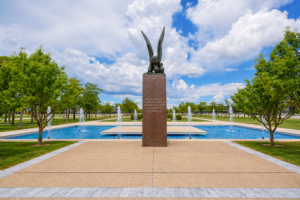 The Terrazzo at the U.S. Air Force Academy
We came from different places, with different backgrounds and ambitions, but accepted a common obligation: to prepare ourselves to serve something larger—a set of ideals and principles. The bond that grows from that shared commitment, and the willingness to embrace its associated risks, is familiar to anyone who has worn the uniform.
Thirty years on, most of my graduating class have now completed military careers, found their way back into civilian life, and stepped out of the formal fight. A few though, still wear the uniform today – still serve, still lead. We owe them, and all those who have answered our nation’s call an enormous debt.
So this Veterans Day, I find myself reflecting on that bond first forged three decades ago, and what we owe our fellow veterans still today. I have come to believe that honoring means more than a performative “thank you” from policymakers – it means investing in the tools of national power that help prevent war in the first place and supporting our servicemembers from deployment through their return if war becomes necessary.
It requires us to invest in forward-looking diplomacy, effective international assistance, and the vital relationships with partners that are the cornerstone of our alliance system and force projection around the world.
In my current role leading the U.S. Global Leadership Coalition’s Veterans for Smart Power initiative – a network of veterans committed to leveraging all of our strength as a nation – I am privileged to advocate alongside thousands of fellow veterans from across the country for precisely those types of strategic investments.
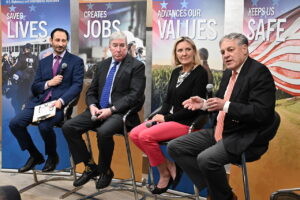 Adam Svolto moderates a Veterans for Smart Power panel discussion.
Without question, a strong military is essential to deterring would-be aggressors and defending our country should force become necessary. Our military’s unparalleled strength, though, serves us best within a comprehensive strategy that also draws on our diplomatic relationships, strategic assistance programs, and economic influence.
This notion was reinforced early and often in our officer training, starting at the Academy. Our earliest Military Arts and Sciences course introduced the “DIME” framework of national power: Diplomatic-Informational-Military-Economic.
Later, my experience as an aviator illustrated the complementary nature of these levers of power. I learned the important role diplomacy played in securing access, basing, overflight permissions, and intelligence sharing. An aircraft’s capability and its crew’s readiness matter tremendously, but realizing their full potential requires partnership, coordination, and commitment from our allies. Those arrangements demand patient, technical work long before an aircrew receives its mission.
Returning to the Academy 30 years later reminded me that the obligation we accepted as young officer candidates still has meaning decades later. For me, fulfilling that obligation means ensuring that all Americans in uniform are supported by every tool of national power.
Our support should be evident not only in the care we provide veterans and their families after service, but also in the scrutiny we apply to the exercise of hard power in the first place. It should be evident in effective international assistance that prevents instability and conflict, advances America’s national security and economic interests, and delivers measurable results. Our diplomats, international development practitioners, and military professionals each have a role to play, and each deserves the means to do the job well.
To honor our servicemembers, we owe it to them to use every tool of national power to prevent conflict wherever possible. And if we must send our sons and daughters into harm’s way, let’s make certain we have invested in relationships with our partners and allies to give them the strongest possible foundation for success. That is a responsibility I still share with the classmates I stood beside thirty years ago.
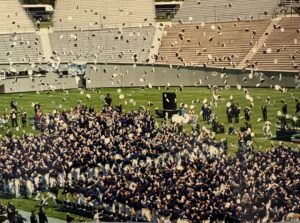 U.S. Air Force Commencement Ceremony, Class of 1996. Photo courtesy of Adam Svolto

Get the latest news, advocacy, and event updates from the USGLC
© 2026 U.S. Global Leadership Coalition | Privacy Policy


