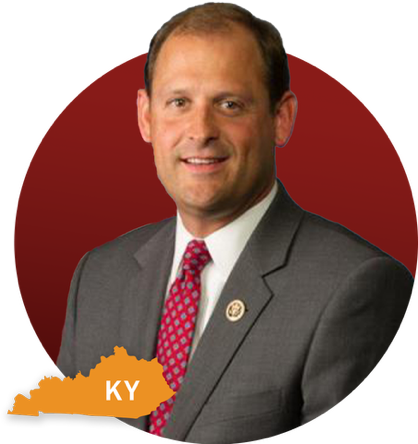
Background on the Senator-elect’s statements, positions, and record on diplomacy, international assistance, and U.S. international affairs programs.
A born-and-raised Kentuckian and seven-term member of the U.S. House of Representatives, Senator-elect Andy Barr has frequently framed U.S. leadership through the principle of peace through strength, stating that “America must lead from a position of strength.”
During his time in the House, Barr engaged with different aspects of foreign policy through his service on the House Foreign Affairs and Financial Services Committees, as well as the Select Committee on the Strategic Competition Between the United States and the Chinese Communist Party. From official travel to places like Taiwan, Japan, and the Middle East to his role as Republican Co-Chair of the Congressional Taiwan Caucus, Senator-elect Barr’s work has focused on strategic competition with China, strengthening U.S. partnerships in the Indo-Pacific and protecting U.S. economic and national security interests abroad.
Prior to his election to Congress in 2012, Barr worked as an attorney in Lexington. He also served in several positions under Governor Ernie Fletcher’s Administration in Kentucky, including Deputy General Counsel, General Counsel, and Special Assistant to the Governor. He graduated from the University of Kentucky College of Law in 2001 and the University of Virginia in 1996.
On U.S. global leadership and America’s role in the world:
- At a May 2025 Foreign Affairs Committee hearing, Barr said, “America First is not America alone.”
- At a June 2021 House Financial Services Subcommittee hearing, Barr said, “American leadership is not disengagement. It’s not retreat. But it is also not subordinating the interests of the United States to other nations, the United Nations or international organizations.”
- In September 2021 Barr called the Peace Corps “one of America’s best diplomatic and humanitarian programs.”
On U.S. international assistance:
- As a member of the Congressional Caucus for Effective Foreign Assistance, Barr has supported strategic, targeted, and accountable international assistance over the years.
- Nonetheless, he voted in favor of last year’s rescissions package to claw back almost $8 billion in international assistance, saying, “We saved taxpayers almost $10B by ending the left-wing slush fund at USAID.”
- Barr has been actively engaged in reforming international affairs agencies to make them more aligned with U.S. economic interests, including in the critical minerals space. In February 2026, he introduced the Millennium Challenge Corporation Strategic Modernization Act, noting that MCC is “well-suited to addressing constraints in critical mineral supply chains.”
- In congressional testimony on locally led development in September 2021, Barr said, “the goal of our foreign assistance and development programs should be to put ourselves, USAID, and the international development community out of a job.”
On global health:
- At a March 2021 Foreign Affairs hearing, Barr said, “We cannot truly bring an end to this pandemic here at home without fighting the pandemic overseas. And I support funding for global efforts to combat COVID-19.” Later that year, he lifted up his work to lead a “successful bipartisan push with over 60 of my colleagues to deliver life-saving COVID-19 vaccines from the United States to Taiwan.”
On America’s alliances:
- After voting for the 2024 national security supplemental to support Ukraine, Israel, and Indo-Pacific partners, Barr emphasized the importance of U.S. alliances and partnerships in an op-ed, writing that “the supplemental funding is more than a financial decision—it’s a strategic investment in our core principles, in the security that shields us, and in a global order that has fostered decades of peace and prosperity.”
- After a 2024 congressional delegation to Taiwan, he noted that “we want to be clear in our support for a democratic Taiwan and condemn any CCP aggression or military encirclement of the island. The United States stands with Taiwan.”
- Barr’s record on Ukraine has been supportive but not uniform. He voted in favor of emergency supplemental assistance in 2022 and 2024 but opposed the 2026 Ukraine Support Act, which would provide additional security funding to the country. He later joined the bipartisan 2026 Lindsey O. Graham Sanctioning Russia and Iran Act, stating that “harnessing America’s full strength—from our financial system to our military—is essential to deterring aggression, defending our allies, and advancing peace.”
On global competition with China:
- Just before the House passed Barr’s Countering the PRC Malign Influence Fund Authorization Act of 2023, he said, “We need to invest in the tools of diplomacy that we have to counter PRC malign influence in the world. We need to support… the Export-Import Bank… the Development Finance Corporation… Peace Corps.”
- Barr also helped lead successful bipartisan legislation to establish U.S. embassies in Vanuatu, Kiribati, and Tonga, saying that “strengthening relationships in the Pacific will help counter the Chinese Communist Party’s belt and road initiative in the region and greatly advantage the United States in its ongoing competition with the CCP.”
- At an April 2024 Foreign Affairs Committee hearing on U.S.-made water purification systems in Africa, Barr said, “there’s a strategic value in providing that soft power overture to places in Africa where Belt and Road is alive and well and where we can counter with U.S. aid efforts.”
On global economic engagement:
- Consistently advocating for U.S. global economic leadership, Barr believes that “from trade and manufacturing to U.S. investment, we need to strengthen Kentucky businesses through opening markets to maintain America’s economic dominance.”
- Barr has recognized the International Monetary Fund’s (IMF) role in “promoting international macroeconomic stability” while arguing that the IMF and World Bank should focus on their core missions and face stronger oversight and accountability.
On conflict in the Middle East:
- At the time of a March 2026 Senate debate on the Iran war, Barr said, “The president has the legal authority as commander-in-chief to defend the country, and Congress has the power to declare war, but Congress does not have the power to prevent the president from advancing our national security.”
Download PDF