As America celebrates 250 years, nearly 500 business, veteran, humanitarian, farmer, faith, and bipartisan political leaders converged in Washington to share real stories of how America wins when America leads. Here are some highlights and videos from each session:
AMERICA WINS WHEN AMERICA LEADS
Schrayer on how strategic diplomacy and international assistance can help America shape, lead, and win the next 250 years
“Thank you to our wonderful, incredible, strange bedfellows coalition for making our world just a little better and America a whole lot stronger,” said Liz Schrayer, President and CEO, USGLC. “Our job in this moment is clear—to continue to connect how international assistance doesn’t just save lives, but makes us safer, stronger, and more prosperous right here at home.”
THE STATE OF THE WORLD: CONFLICT, CRISIS, AND THE FUTURE OF GLOBAL STABILITY
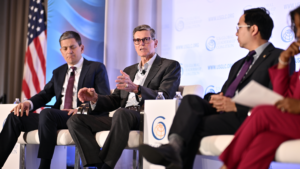
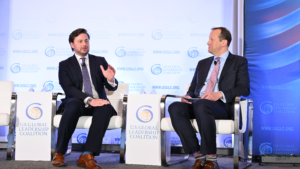
Votel, Kim, Miliband, McKenna on growing global threats facing the United States—from the war in Iran to the Ebola outbreak in Central Africa
On American global leadership: “This is not about charity, this is about global security, it’s about global leadership,” said Senator Andy Kim (D-NJ). “I was at the State Department, I was at the Pentagon, so I’ve seen these three Ds of defense, diplomacy, and development working hand in hand… and it needs to happen comprehensively and strategically.”
On the war in Iran: “This war is not going to be over. There may be a ceasefire, but that doesn’t mean the war is over,” said retired four-star General Joseph Votel, former Commander of Central Command. “The military by itself is not decisive. What is decisive is the diplomatic follow-up that comes with that—the economic tools that are applied in its wake, and the informational aspect we bring to bear—that really consolidates what we do militarily into a strategic victory.”
On disease threats: “The truth about the modern world is that it’s more connected than ever before, and therefore the risks spread faster than ever before,” said former UK Foreign Minister David Miliband, President and CEO, International Rescue Committee. “It’s going to take really determined, patient, strategic engagement for this to be a world that doesn’t just spread risks, but also spreads opportunities and security.”
» Watch the full conversation HERE with Senator Andy Kim; David Miliband; Gen. Joseph Votel; Tjada D’Oyen McKenna, Mercy Corps CEO; and Sen. Norm Coleman (R-MN).
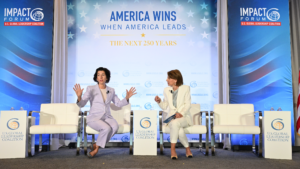
AMERICAN PROSPERITY: A CONVERSATION WITH SECRETARY GINA RAIMONDO
Raimondo on how economic security is national security, importance of investments in assistance and diplomacy to strengthen supply chains and spur trade
On economic security: “If we’re going to continue to lead the world, your tagline for this whole conference is that ‘America wins when America leads’—I couldn’t say it any better. We must invest in us: in our people, in our infrastructure, in our tech, in our economy to be strong,” said former Secretary of Commerce Gina Raimondo. “The whole point is America is strongest when we’re economically and militarily strong, and that brings the world towards us, and so I think that’s how we have to outcompete China.”
» Watch the full conversation HERE with Gina Raimondo, former Secretary of Commerce and former Governor of Rhode Island; former Secretary of Agriculture Dan Glickman; and Liz Schrayer.
AMERICAN PROSPERITY: WINNING THE GLOBAL COMPETITION
Kwon, Kulp, and Baker on the power of U.S. economic development tools and the private sector to outcompete China in the critical minerals and technology races
On critical minerals: “We are investing in transport infrastructure, energy infrastructure, critical minerals infrastructure, so that those deposits can come out and go to the places where they’re needed while also helping those countries,” said Sam Kwon, General Counsel, U.S. Trade and Development Agency. “It has become very clear that’s where the White House wants to focus, and we believe there will be a series of projects that will come out of it strengthening our ability and security over these valuable deposits.”
On private sector engagement: “We spend billions and billions of dollars with our supply chain, and that is going to small manufacturers, that’s going to small businesses, that’s going to companies across the great United States. You can’t do any of that right without the partnership of the U.S. government to create the access, to create the conditions through their diplomacy, through their development,” said Heather Kulp, Vice President of Government Affairs, Chevron. “That enables all of us to win and that means that America is stronger, and it means that the world ultimately gets stronger.”
» Watch the full conversationHERE with Sam Kwon; Heather Kulp; Sasha Baker, Head of National Security Policy, OpenAI; Steve Morrissey, Vice President of Regulatory and Policy, United Airlines; and Sidney Traynham, Senior Policy Director, USGLC.
AMERICA 250: AMERICA’S LEGACY AS A SHINING CITY ON A HILL
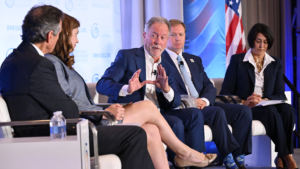
Beasley, Steiger, and Dougherty on how strategic investments in assistance combat global hunger and improve global health outcomes
On food security: “I know when I took over, we were about a five-to-six-billion-dollar operation, and when I left, it was a $14 billion operation. We were stabilizing populations around the world, giving hope to people all over the world, and truly saving taxpayers in America a lot of money, because we were stabilizing populations,” said David Beasley, former Governor of South Carolina and former Executive Director of World Food Program. “When America leads as that city on the top of a hill, the world responds, the world looks to America.”
On global health security: “It was American scientists and American private sector companies and their partners who invented the drugs that made it possible for us to treat HIV,” said Dr. Bill Steiger, CEO, Malaria No More. “Whole societies were at the risk of falling apart when teachers and security officials and government officials and the commercial sector were all at risk of dying off. That posed a demonstrable risk to American security, especially in Sub-Saharan Africa.”
On investments in nutrition: “Prenatal vitamins prevent stunting, small births, stillbirths,” said Maggie Dougherty, Vice President of North American Advocacy, Eleanor Crook Foundation. “So, these are one of the innovations that is made in America, supported by Americans, and saving lives all around the world.”
» Watch the full conversation HERE with David Beasley;Maggie Dougherty; Dr. Jenelle Krishnamoorthy, Senior Vice President of Global Policy and Public Affairs, Merck; Dr. Bill Steiger; Sean Callahan, President and CEO, Catholic Relief Services; and Beverly Bashor, Assistant General Counsel, Compassion International.
IMPACT 2026: THE FUTURE OF INTERNATIONAL ASSISTANCE
Mowers, Richardson, Parker on Trump Admin approach and opportunities to deliver strategic, effective, and accountable international assistance
On advancements in global health: “I think the really exciting one is the advancements in the prevention and treatments. You have long-term acting PReP, Lenacapavir, the public-private partnership that Global Health Security and Diplomacy at the State Department launched with Gilead,” said Matt Mowers, President, Valcour LLC and former Trump White House Senior Advisor. “The number of free doses they’re putting out there—if every single individual who could potentially contract HIV takes Lenacapavir once every couple of months, you’re going to stop the disease. That’s incredible progress.”
» Watch the full conversation HERE with Matt Mowers; Jim Richardson, National Outreach Director, USGLC; Richard Parker, Senior Policy Advisor, USGLC.
TEAM USA: LEADING A DECADE OF SPORTS DIPLOMACY
Placek on the role of sports as a foreign policy tool as the U.S. prepares to host FIFA World Cup games and 2028 Olympics
On sports diplomacy: “There’s hunger for this type of engagement, and we want to figure out how we can maximize the impact of sports diplomacy. It’s sometimes talked about as soft power, and soft power is great; however, it’s strategic power,” said Rob Placek, Senior Advisor for Sports Diplomacy, U.S. Department of State.
» Watch the full conversation HERE with Rob Placek; Reggie Gray, President and CEO, Houston Intercontinental Chamber of Commerce; and Richard Parker.
IMPACT 2026: GLOBAL LEADERSHIP AND THE MIDTERM ELECTIONS
Erickson and Elrod on foreign policy and the upcoming midterm elections
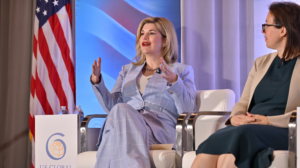
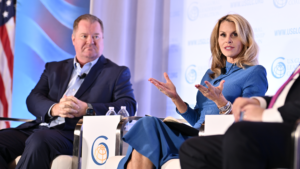
On the midterms: “Typically, foreign policy does not drive elections, it doesn’t motivate voters in the same way that the economy does, and other kitchen table issues, but I think this one is different,” said Adrienne Elrod, Democratic strategist and Co-Founder, Elrod Gifford Group.
On America’s role in the world: “I firmly believe, because I’ve seen it firsthand, that the United States not only has a role to play in the world, obviously, but should be leading,” said Erick Erickson, Conservative Commentator and Host, The Erick Erickson Show.
» Watch the full conversation HERE with Adrienne Elrod; Erick Erickson; Mayor Michael Owens, City of Mabletown, Georgia; and Jason Gross, Executive Director, USGLC.
FROM SURVIVAL TO SERVICE, TURNING PAIN INTO PURPOSE
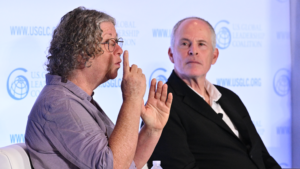
Keith and Aviva Siegel on surviving Hamas captivity and their humanitarian mission to spread good in the world
“Going through what I went through in Gaza—I was starved while they ate in front of me and smiled,” said Aviva Seigel. “One of the days, Keith said to me after I asked, please just ask once more for water, he begged, and we didn’t get water. So, for me to think about people in this world now, 2026, that haven’t got the basic water, just water. We have to help them.”
» Watch the full conversation HERE with Keith and Aviva Siegel, Captivity Survivors and IsraAID Ambassadors; and Liz Schrayer.
USGLC CAPITOL HILL DAY
On Day 2 of the Impact Forum, hundreds of our state leaders spread out across Capitol Hill for dozens of meetings with Senators and Members of Congress to thank Congress for passing a FY26 budget that funds the tools America needs to win and lead, and to urge continued support for smart, strategic investments in international assistance and diplomacy—on the same day that Secretary of State Marco Rubio was testifying before Congress on the Department of State’s FY27 budget request (more on this below).
Meetings included Jerry Moran (R-KS), Sen. Jon Ossoff (D-GA), Sen.Todd Young (R-IN), Sen. Chris Coons (D-DE), Sen. Lisa Blunt-Rochester (D-DE), Rep. Jefferson Shreve (R-IN), and Rep. Chris Pappas (D-NH), and more.
As USGLC leaders took our message to Capitol Hill, Secretary of State Marco Rubio testified before the four key appropriation and authorizing committees, with bipartisan members and senators raising many of our core themes.
Lindsey Graham (R-SC)on soft power: “Soft power to me has the potential to make us safer in very troubled parts of the world… global health and humanitarian aid are again national security in another form.” (See video clip here on X)
Secretary Rubio on South Korea’s shift from aid recipient to trade partner: “South Korea used to be an aid recipient… Today, South Korea is the ninth largest economy in the world, and they are a donor state.” (See video clip here on X)
Senator Susan Collins (R-ME) on GAVI: “Gavi, as you well know, plays a critical role in preventing the spread of infectious diseases around the globe and helps to protect public health in our country as well by stopping outbreaks before they reach our borders. And that’s particularly important right now as the world is responding to the Ebola outbreak in the DRC.” (See video clip here on X)
Senator Jeanne Shaheen (D-NH) on Ambassador vacancies: “Right now, the United States has more than 100 vacant ambassador posts…in Africa alone, 37 of our 51 embassies have no ambassador, and China’s filling that vacuum.” (See video clip here on X)
SFOPS Ranking Member Brian Schatz (D-HI) on the Global Fund: “You have $2.5 billion in unspent funds we provided specifically for the Global Fund… there’s still $661 million that you could move tomorrow morning.” Sec. Rubio response: “I think that will move shortly—very quickly.” (See video clip here on X)
SFRC Chairman Jim Risch (R-ID) on the Ebola outbreak: “The Ebola outbreak in Eastern Congo, now affecting the entire region, highlights how conflict and humanitarian crises abroad threaten the health and security of the American people here at home.” (See video clip here on X)
NSRP Ranking Member Lois Frankel (D-FL) on American leadership: “Diplomacy prevents conflicts before they erupt… a global health program stops outbreaks before they reach our shores; development reduces the desperation that fuels extremism; and strong alliances ensure that we do not face threats alone. That’s how America leads.” (See video clip here on X)
Over the past decade, China’s Belt and Road Initiative (BRI) – a series of development and investment projects across Central Asia, Africa, and South America – has extended more than $182 billion in loans to 49 African countries, building roads, railways, ports, and power facilities with few governance conditions attached. These finance projects have positioned China as Africa’s largest lender, with 30 of 49 African countries now on interest payments than on public health.
This debt has become a geopolitical exploit for China, especially in regions like the Sahel where security and economic vulnerabilities are increasingly urgent. But it also presents a critical opening for the U.S. to demonstrate a different approach that prioritizes accountability, partnership, and sustainable economic growth.
In a hyper-connected world where diseases cross borders with increasing ease, American leadership in disease prevention and treatment is vital to protect Americans at home and abroad. In 2024, 40.8 million people—and 4.2 million Americans—were living with HIV worldwide. Each year 630,000 people die of HIV-related illnesses globally. It is in the United States’ strategic interest to work with urgency toward an HIV-free generation.